SK hynix ADR: Same Business, Different Return
Compare SKHY with Seoul shares using the depositary ratio and FX. Then separate an open conversion book from actual execution and premium risk.
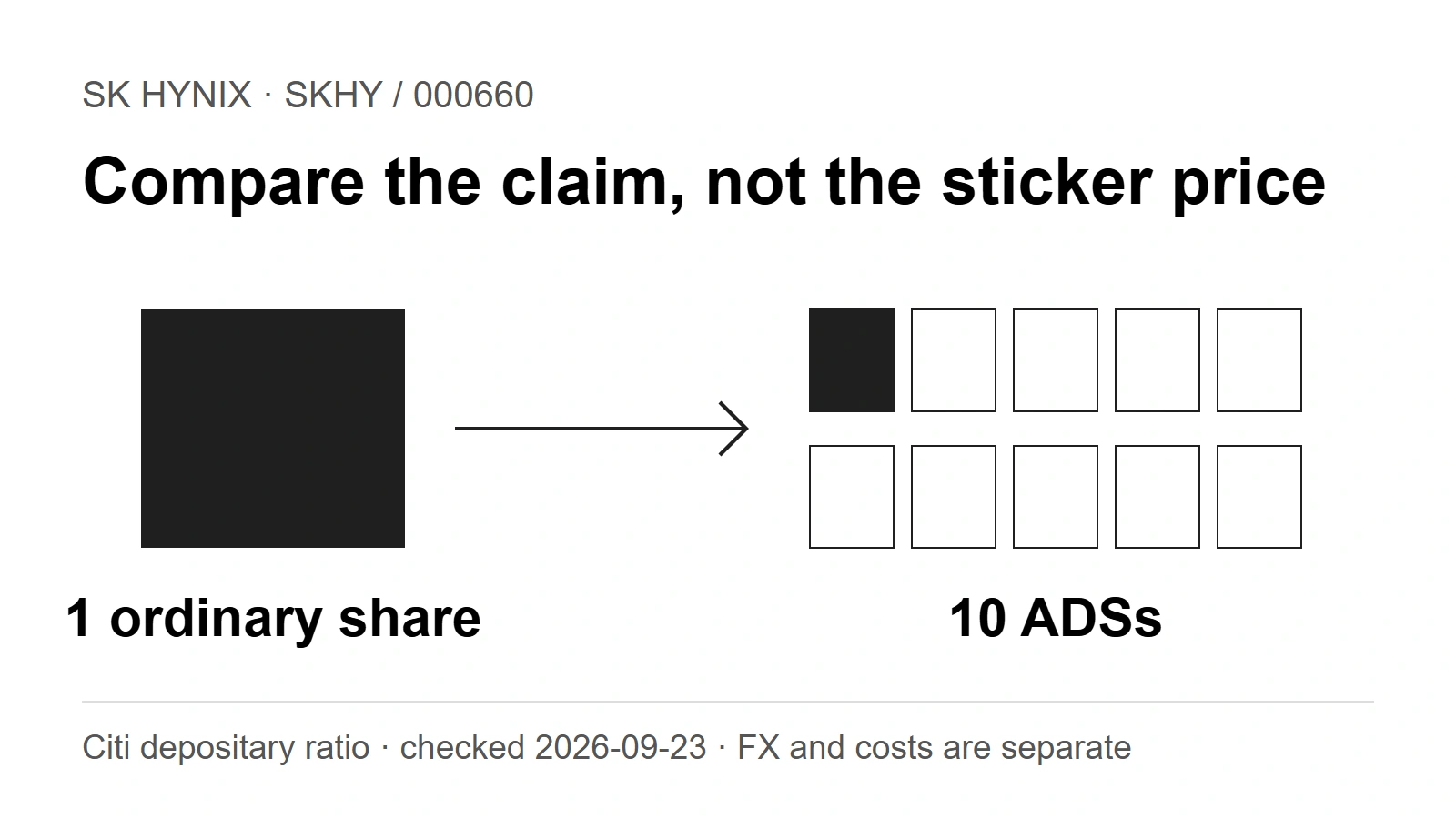
If you want SK hynix exposure, the smaller number beside SKHY is a poor place to start. A U.S. depositary share represents only a fraction of a Seoul share. Compare the wrong quantities and the apparent bargain disappears before fees even enter the calculation.
Ten SKHY ADSs represent one ordinary share. That ratio is the first check; the price paid for U.S. access is the second. The same memory business can produce different investment returns if the premium attached to one trading route changes.
Start with the same amount of stock
The offering prospectus defines an ADS as one-tenth of a common share. ADR is the familiar name for the depositary receipt; ADS is the unit used in the offering and the calculations below. Neither is an extra claim on the company's factories.
This worksheet puts the quotes on the same basis. Keep the timestamp beside every input, including the exchange rate.
| Input or step | What to use | What the result means |
|---|---|---|
Seoul price, P | Won per ordinary share | The full local share, not an ADS |
Exchange rate, F | Won per U.S. dollar | Divide P by F to convert won into dollars |
Gross ADS parity | P ÷ F ÷ 10 | Dollar value of the underlying fractional share, before costs |
SKHY price, A | Dollars per ADS | The U.S. trading price |
Gross premium | A ÷ parity − 1 | Excess over underlying parity, not expected return |
Explanation: Hynexly calculation using the depositary ratio. These are variables, not current market quotes. A positive gross premium is not a measured, executable profit.
Reversing the exchange rate is an easy mistake. If more won buy the same dollar while the Seoul price stays unchanged, its dollar value falls. Dividing by won per dollar captures that direction. Multiplying does not.
Matching calendar dates is not enough, either. A Seoul closing price and a later U.S. closing price describe different moments. News between the observations can look like a premium even when the underlying value has moved.
What the open conversion book tells us
Citi's program page showed OPEN when checked on 2026-09-23. It identifies SKHY, the 1:10 ordinary-share-to-DR ratio and 2026-07-29 as the notice's reopening date for issuance and cancellation.
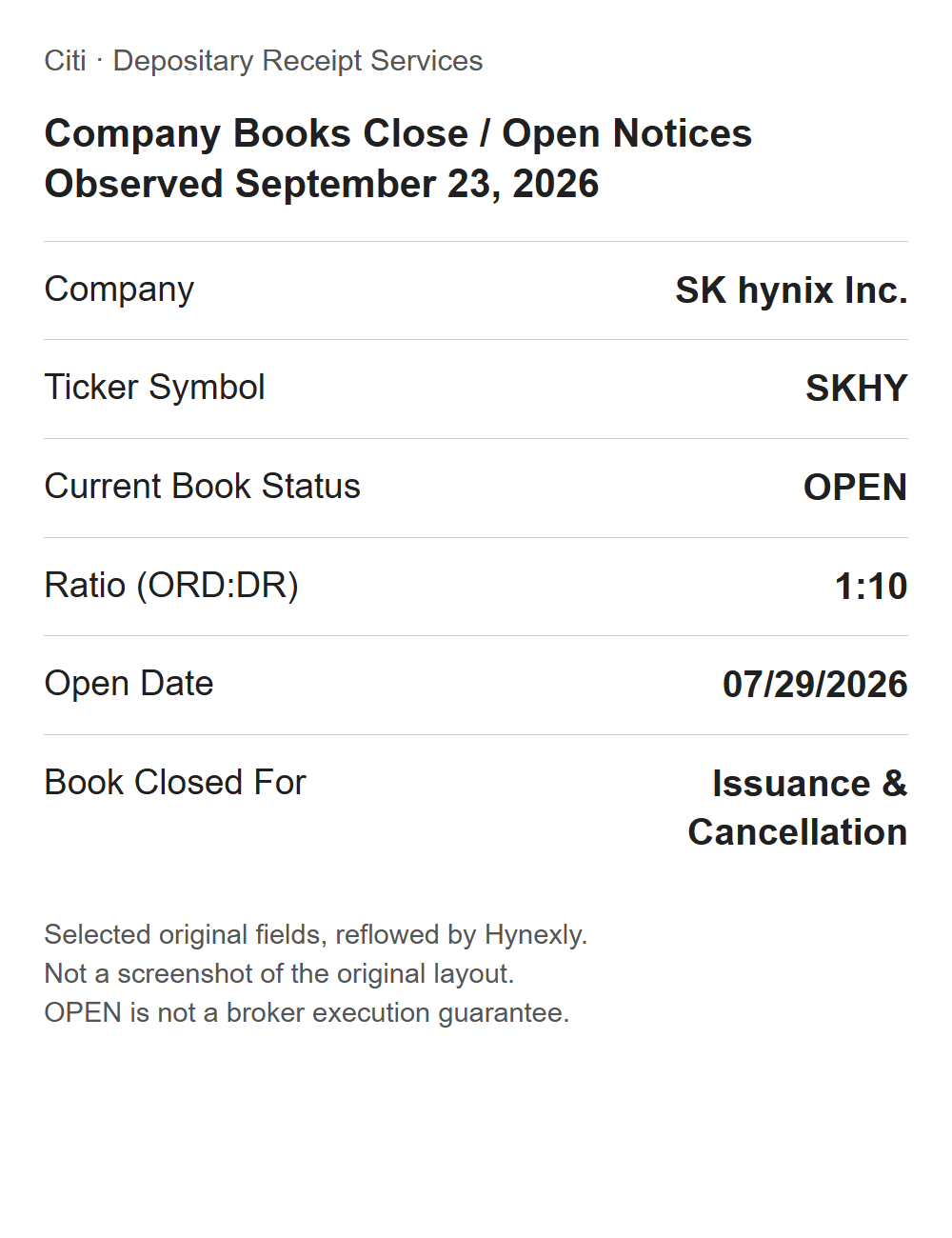
That is useful evidence against an explanation based entirely on a closed depositary book. It does not tell us how many shares are being converted, which investors can use the route, or what they pay.
There are two different questions: can the program accept issuance and cancellation, and can this investor complete a conversion on workable terms? The second requires a broker or custodian's current instructions. A website status cannot answer it.
The fee schedule in the prospectus permits issuance and cancellation charges of up to $5 per 100 ADSs, or a fraction thereof. Additional charges can apply. Treating that as a universal, all-in five-cent conversion quote loses both the partial-lot wording and the other costs. The SEC-filed deposit agreement also describes documentation requirements and currency-conversion charges.
A premium can erase a good business result
The refreshed review does not establish today's SKHY premium. The earlier version's July comparison is not a substitute for new, timestamped prices and FX. Without those inputs, assigning the current spread to scarcity, investor enthusiasm or arbitrage would outrun the evidence.
We can still show why the spread matters. Consider a deliberately hypothetical example: underlying dollar parity is indexed to 100, while the ADS costs 120. The entry premium is 20%. If underlying parity is unchanged and the premium disappears, the ADS falls to 100. The holder loses 16.7%, before costs.
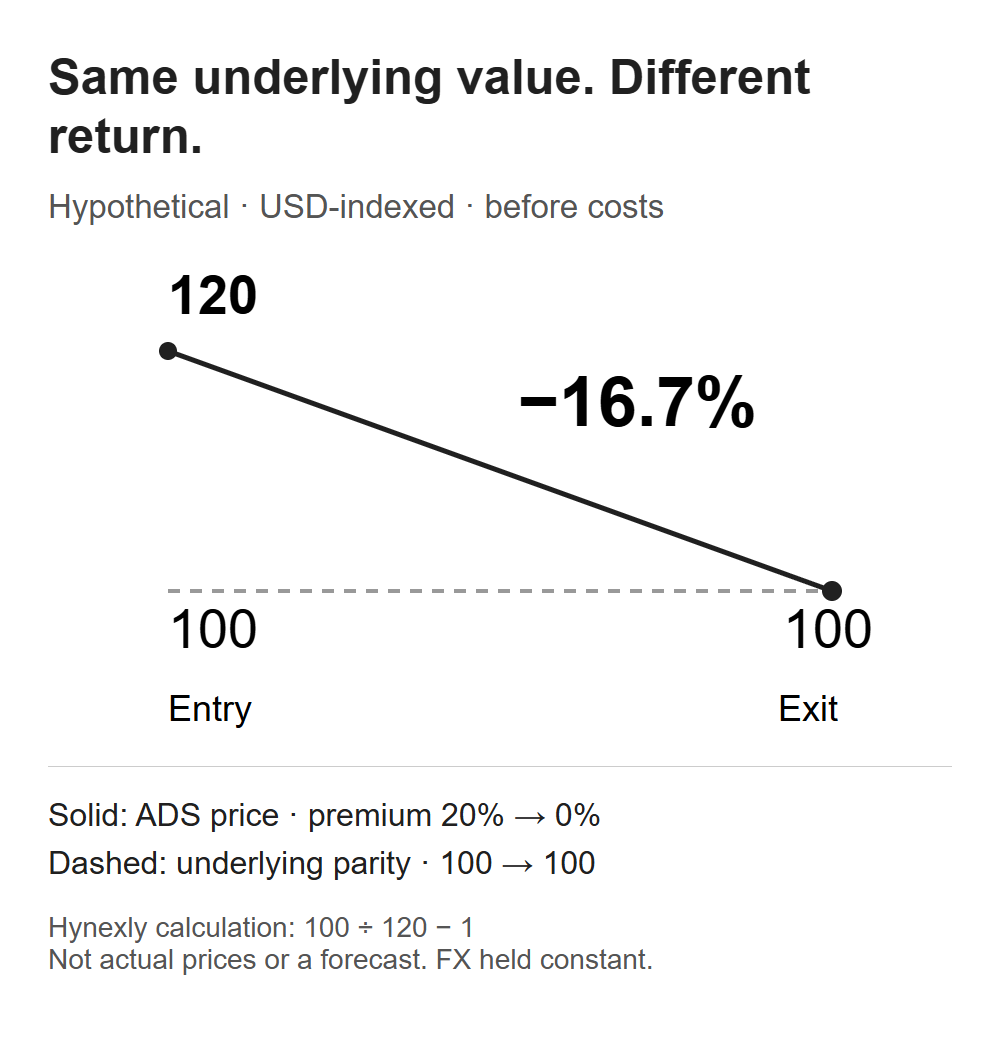
The loss is measured against the higher purchase price, not the underlying starting value. That denominator explains why losing a premium is not the same percentage as paying it.
| Underlying dollar-parity change | Entry premium | Exit premium | ADS price return |
|---|---|---|---|
0% | 20% | 0% | −16.7% |
+5% | 20% | 0% | −12.5% |
+20% | 20% | 0% | 0% |
Explanation: Hypothetical scenarios, not probabilities or forecasts. ADS return = (1 + underlying dollar-parity change) × (1 + exit premium) ÷ (1 + entry premium) − 1. The same exclusions apply.
This cuts both ways. A widening premium can lift the ADS relative to the underlying shares. A narrowing premium can hurt even when the operating thesis remains intact. Neither movement alone tells us whether demand for high-bandwidth memory has improved.
New capital is different from routine conversion
The original offering did change the company. The completed capital-increase filing records 17,790,000 new common shares and $26.5071B of gross offering proceeds. It translates that amount to KRW39,890,534,790,000 using the closing-date exchange rate. Those are the same proceeds in different currencies, not two pools of money.
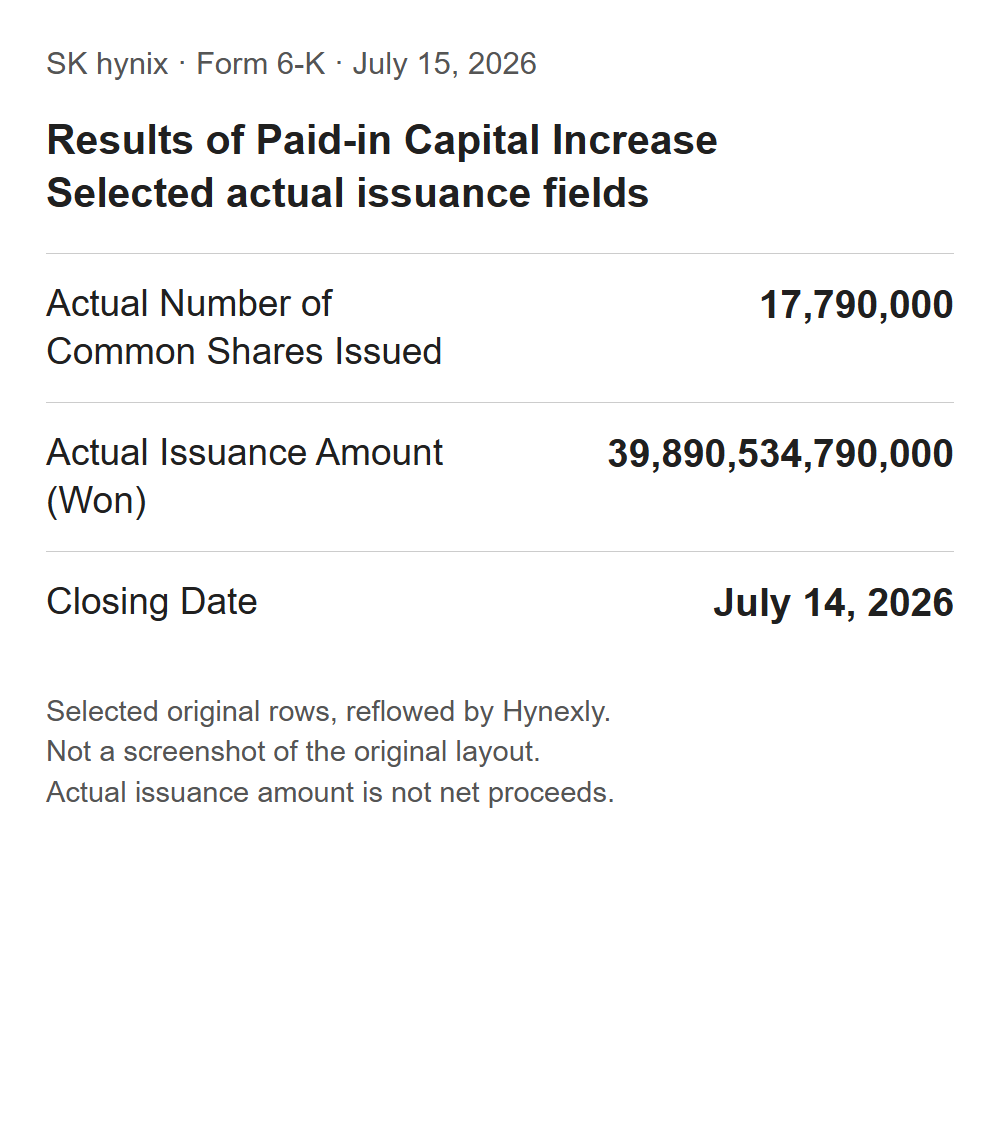
Creating ADSs from already-existing deposited shares is a different operation. It changes how that ownership is represented; it does not by itself mean the company has issued another batch of common shares. Confusing the two overstates the dilution implied by an expanding depositary supply.
The operating countercase also deserves weight. The preliminary Q2 filing reported KRW79.319T of revenue and KRW60.543T of operating profit, rounded here. These were provisional, unaudited figures. They explain why access to the business could attract interest; they do not establish an appropriate premium for a particular listing.
What could make U.S. access worth paying for?
Convenience has value. An investor may prefer a U.S. account, dollar dealing and familiar custody. The mistake is treating that preference as evidence that any price gap is justified—or that the gap must vanish immediately.
| Consideration | Possible benefit | Boundary to check |
|---|---|---|
Account access | A workable route to the company | Whether direct Seoul ownership is actually available to that investor |
Trading and custody | Familiar operating arrangements | Broker support, settlement and handling charges |
Currency | Dollar-denominated dealing | The Korean underlying business and FX exposure do not disappear |
Conversion | A route between representations | Eligibility, paperwork, fees and timing; OPEN alone is insufficient |
A holder faces business risk and access-price risk together. The memory cycle can weaken in both listings. Separately, the ADS premium can contract without a deterioration in factory economics. An attempted convergence trade adds execution and, where relevant, financing or borrow risk; gross parity does not account for them.
What would change the explanation?
The useful test is a sequence of observations, not a countdown to an assumed convergence date.
| Next observation | What it would support | What it would not prove |
|---|---|---|
Repeatable, timestamped price and FX comparisons | A reliably measured gross gap | A net return available to every account |
Documented conversions with known timing and costs | A functioning practical route | Unlimited capacity or a guaranteed closing date for the gap |
Persistent gap despite workable conversion | Launch scarcity alone is incomplete | The remaining premium is permanently justified |
Shrinking gap as conversion becomes practical | Supply and access friction may matter | That operating prospects have worsened |
Before the next price-based update, collect the quotes, FX convention, depositary status and actual conversion terms together. Until then, the defensible conclusion is about how to compare the instruments, not which one will outperform.
Method and disclosure
Sources were rechecked on 2026-09-23. The ratio and completed capital increase are reported facts; the indexed return examples are Hynexly calculations under explicit assumptions. This refresh removes the old current-sounding premium claim and does not present a live valuation or broker-specific advice.
For the business behind the security, the Micron contract-and-margin analysis follows the memory cycle. The Nvidia cash-conversion review examines an earlier accelerator-demand checkpoint; it is context, not a current SKHY pricing input.
AI assisted with research organization, arithmetic and bilingual editing. No independent human review is implied. This is general financial information, not an individualized recommendation, rating or price target.
Frequently Asked Questions
Ten ADSs represent one SK hynix common share. Divide the won ordinary-share quote by won per U.S. dollar and by ten to calculate gross ADS parity.
No. Program status is separate from account-level conversion support, timing, fees and documentation.
This review does not establish it because synchronized stock and FX observations were not obtained. Historical comparisons are not used as current quotes.
Primary references cited or linked in this analysis. Click through to read each source in full.
Choose the next evidence gap to investigate.
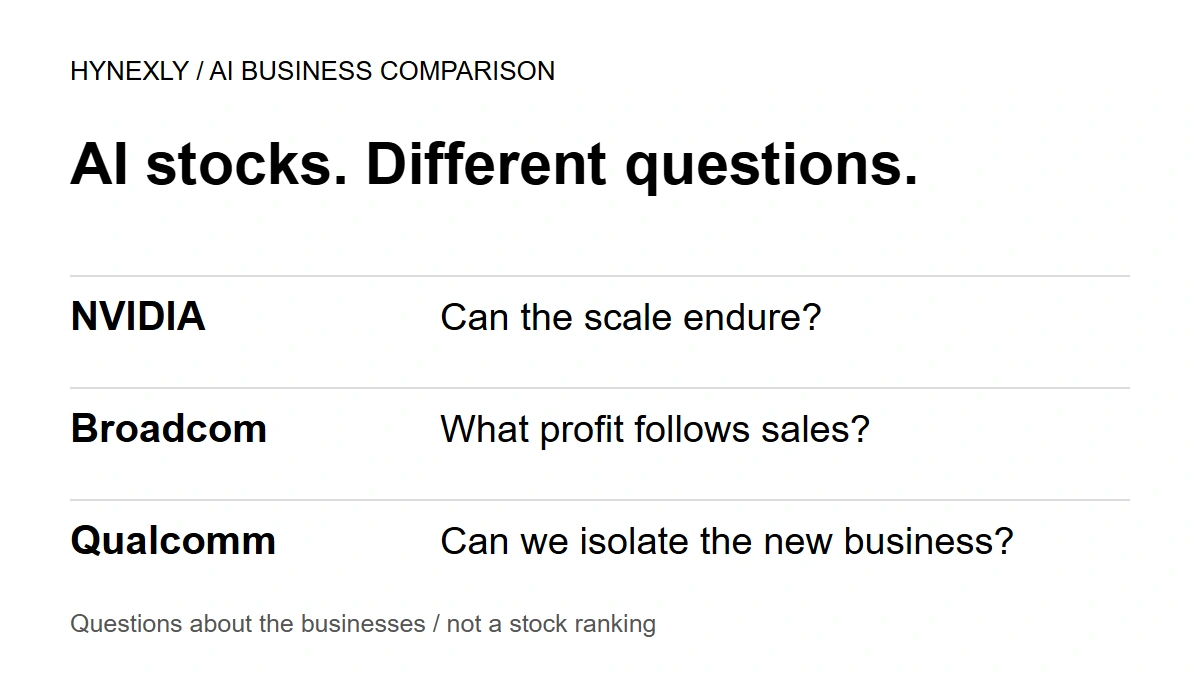
NVIDIA, Broadcom, Qualcomm: What Each AI Business Still Has to Prove
NVIDIA and Broadcom already depend heavily on different AI-related businesses. Qualcomm has real revenue and an Amazon collaboration—but a separate financial ramp to prove.
Owner-operated US market research desk
Owner-operated US stock and market coverage built from public filings, SEC EDGAR, official reports, company releases, and market data.
- Source-grounded research with primary filings & official reports
- Bilingual EN / KO editorial workflow
- Manual editorial QA before publish