Tech & Tools
What ChatGPT, Gemini, and Claude Can't Replace in Stock Research
ChatGPT, Gemini, and Claude in stock research — kept subordinate to filings, source-derived evidence maps, and editorial verification. A 2026 operating model, not a hype pitch.
Thesis
(Sources: SEC Investor Alert - Artificial Intelligence (AI) and Investment Fraud, OpenAI Models, Google AI for Developers - Gemini API Models, Anthropic Docs - Claude Models Overview)
Do any of the three vendors claim, anywhere in their own documentation, that their model can pick stocks? No. OpenAI's models docs, Google's Gemini API models page, and the Anthropic Claude models overview describe capabilities, full stop; stock-picking accuracy appears nowhere. Confirming that was step one here. Step two: before writing a line, we re-read the SEC's AI-and-investment-fraud alert, because that warning, not any model spec sheet, is what fixes where evidence has to come from.
Related reading: What BrokerCheck and SIPC Reveal Before You Fund an Investing App | What the 2026 FOMC Calendar Says About When Fed Cuts Can Come | Verify Your Broker Before You Pick a Single U.S. Stock
Asking which chatbot is "best" for investing is the wrong opening move. Stock research is not one task; it is a chain of five distinct tasks — locating the right source, extracting exact numbers, checking whether the period matches, building a scenario note, and stripping unsupported language before publication. No single "best" answer survives that chain, because a model that wins on prose can still fail on sourcing.
That means the correct operating model is not to pick one "winner" and let it do everything. The correct operating model is to assign each model to the part of the workflow where it creates the most value and the least verification burden.
The SEC's own AI fraud warning is the right place to start. It does not say AI tools are useless. It warns readers to be skeptical when AI is used to create credibility without real evidence. That applies just as much to a blog workflow as it does to a scam promotion. If a model-generated paragraph sounds confident but does not point back to a filing, investor-relations page, regulator release, or clearly attributable quote surface, it is still low-quality research.
Source Evidence Snapshot
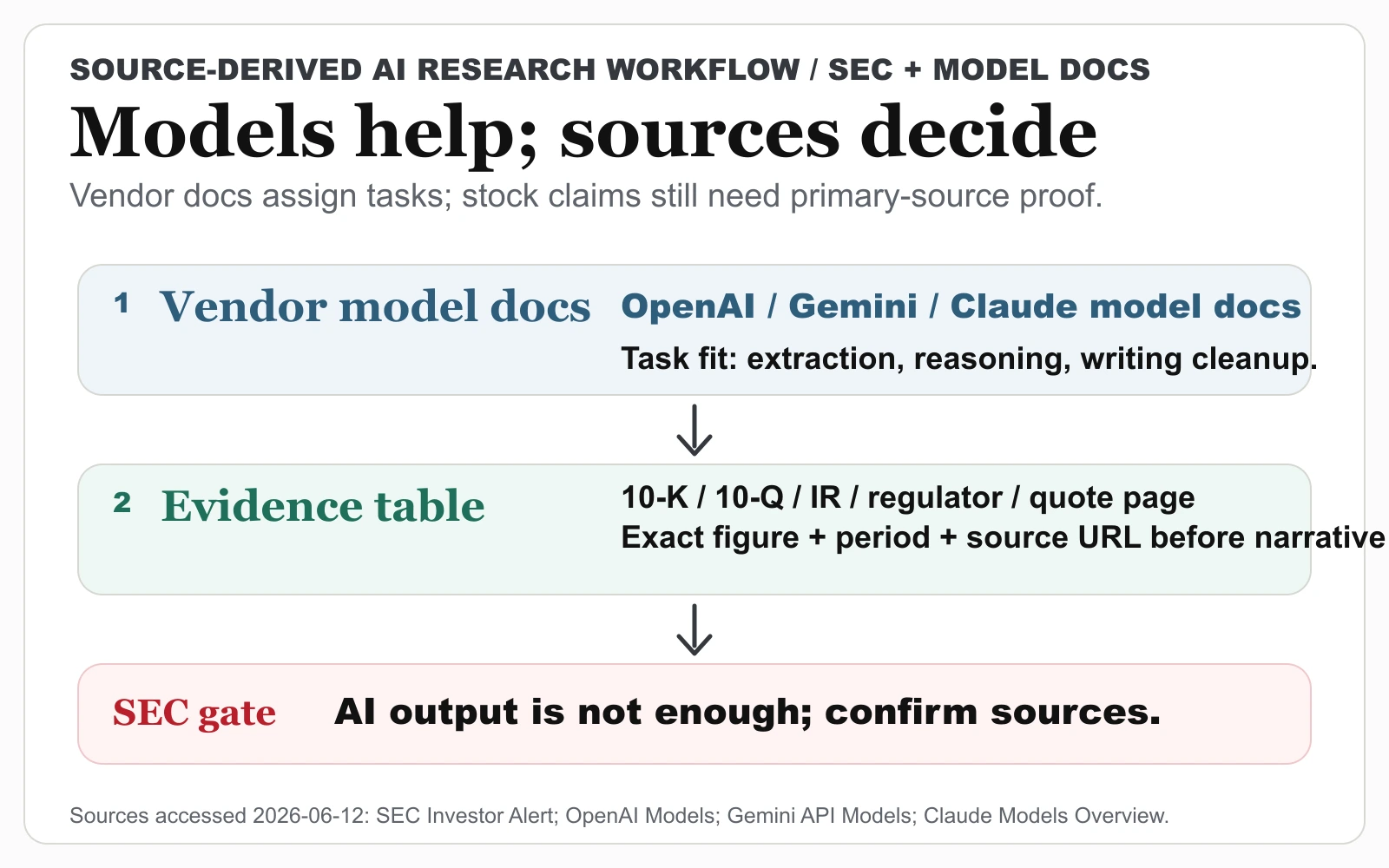
The hero map replaces raw vendor-page screenshots with a source-derived evidence hierarchy: vendor docs assign tasks, filing/regulator/quote pages carry publishable claims, and the SEC investor alert sets the guardrail. OpenAI, Gemini, and Claude remain linked vendor-documentation context rather than stock-picking proof.
 Source-derived publish gate: Based on the SEC Investor Alert on AI and investment fraud, OpenAI Models, Gemini API Models, and Claude Models Overview, accessed 2026-06-12. It separates evidence assembly from reasoning/framing and blocks claims without source links.
These vendor pages do not prove that one model "beats" another in stock picking. They support a narrower publication point: vendor documentation can help assign workflow roles, but it cannot replace sourcing, verification, and editorial review.
What a Publish-Safe Comparison Actually Needs
The useful comparison is not brand loyalty. It is operational fit. For publication-safe stock research, a model has to survive five checks before its output is allowed into a draft:
Source traceability: every non-trivial claim must map to a named filing, report, regulator page, exchange page, or quote surface.Numerical stability: the important figures should not drift between reruns.Scope control: the answer has to stay inside the stated ticker, quarter, and scenario frame.Uncertainty labeling: unsupported statements must be marked as hypotheses, not delivered as facts.Edit burden: the final human verification pass should be manageable rather than a full rewrite.
This is the main point most AI-comparison posts miss. An answer can read better and still be riskier to publish. Note that these are five pass/fail gates, not a scorecard: an output that clears four of the five — say, traceable, stable, scoped, and labeled, but still a near-full rewrite on edit burden — does not qualify as publish-safe. The bar is all five, not a majority.
Where Each Model Usually Fits Better
The official model pages do not test financial analysis quality directly, but they still help define a safer workflow. They tell you which vendors are prioritizing broad multimodal access, long-context retrieval, or heavier reasoning modes. That matters because stock-research tasks are heterogeneous.
In practice, the work usually splits into three buckets.
1. Retrieval and Extraction
This is the phase where the analyst gathers the 10-K, 10-Q, earnings release, investor deck, exchange quote, or regulator page and turns them into structured notes. The output here should be boring and exact. If the source says revenue was $4.6 billion, the note should say $4.6 billion, not "roughly mid-single-digit billions."
This phase rewards:
- long-context document handling,
- clean citation discipline,
- and minimal improvisation.
If a model starts summarizing before the evidence table is fixed, the workflow is already drifting toward low-value content.
2. Counterargument and Scenario Work
Once the evidence table is fixed, a second pass can be useful for asking harder questions:
- What breaks the positive case?
- Which assumption is doing most of the work?
- Which KPI would invalidate the thesis next quarter?
This is where reasoning depth matters more than prose polish. A good model here should pressure-test the thesis rather than decorate it.
3. Editorial Cleanup
The final pass should be the least glamorous part of the workflow: tightening headings, simplifying transitions, and removing unsupported adjectives. This is where model output is closest to normal editing rather than finance analysis.
That is why the role-based model is safer. A single model can be good enough at all three stages, but separating the roles makes hidden failure easier to detect.
The Biggest AI Research Workflow Mistake
The biggest mistake is publishing the narrative before freezing the evidence.
That failure mode usually looks like this:
- The user asks for a quick stock view.
- The model responds with a persuasive summary.
- The summary includes a few real numbers and several blended assumptions.
- The user then backfills sources around the already-written thesis.
That is exactly backward. The source table should exist first. The explanation should come second. This sequence matters because it changes what the model is allowed to do. Before the evidence is fixed, the model is a retrieval and structuring tool. After the evidence is fixed, it becomes a reasoning and editing tool.
A Practical Workflow for Stock Research
The safer operating model is a two-pass system.
Pass 1: Evidence Assembly
Use the model to:
- collect the relevant filing or IR pages,
- list the exact figures you need,
- surface footnotes worth checking,
- and create a clean evidence table with period labels.
This pass ends only when every important number has a named source.
Pass 2: Reasoning and Framing
Only after the source table is locked should the model:
- build upside/base/downside scenarios,
- translate the data into plain language,
- flag assumptions,
- and help structure the article.
That ordering cuts down hallucinated precision and makes publication review much faster.
What This Means for a Grounded Research Workflow
For a grounded investing blog, the winner is not the model with the slickest answer. The winner is the workflow that forces every answer to survive source verification.
That means:
- do not publish "we tested" language unless there is real test evidence,
- do not treat model output as if it were a filing,
- do not let a product-comparison article stand without visible source evidence,
- and do not use AI tools as an excuse to lower documentation standards.
If the article is ultimately about a stock, the publish-safe evidence still has to come from the company, the exchange, the regulator, or a clearly attributable market-data surface. AI models can accelerate the workflow, but they do not replace the proof layer.
What Changes the AI Research Workflow
ChatGPT vs Gemini vs Claude is not a one-time ranking problem for investors. It is an operating-design problem.
For stock research, the durable edge is not which model sounds smartest. The durable edge is evidence discipline: source-linked claims, exact periods, repeatable verification, and a workflow that keeps narrative output subordinate to real documents. That is what separates a useful research tool from low-value filler.